Saturday, 29 December 2018

Word of the Week: Foundationalism


Meet Susan Haack - a new foundationalist.

Are there secure foundations to knowledge? 'Foundationalism' is a theory of knowledge, or how we justify our beliefs. Foundationalists think all beliefs ultimately get their justification from a set of very basic beliefs or sensory states which are the 'foundations' of knowledge. Otherwise, there'd be no foundation, and to fully justify any claim we'd have to say 'A is the case, because B, because C, because D', and so on until infinity! Foundationalists think infinite justification is absurd, so they prefer to base knowledge claims upon a secure foundation - a bit like building a house on rock, not on sand...

So there ought to be secure foundations for knowledge. But it is difficult to see what these foundations really are. The general form of foundationalism seems to be acceptable, but it is difficult to point to the content of any particular theory. There are secure foundations out there, but we don't really know what they are! Perhaps a moderate solution is needed: we might admit that Susan Haack is right in embracing 'foundherentism', which combines the 'foundationalist' insight with the 'coherentist' view that beliefs can justify each other without resting solely on a bedrock of 'basic' beliefs which don't need further justification. Foundationalists think knowledge is like a pyramid. Coherentists think it's like a web: not only does basic belief B justify derivative belief D, but D also can justify B and vice versa - within webs of reinforcing beliefs. Perhaps by 'secure' foundations we don't mean an indubitable foundation but some kind of sound basis for knowledge which can be strengthened by coherence relations and, perhaps, reliable processes too. Contrary to Descartes' assertion that we can all be dead certain of certain beliefs - e.g., 'I exist' and 'God exists' - maybe knowledge has somewhat weaker, but still significant, foundations. The alternative is the scepticism which results from rejecting basic beliefs.

To start with, let's consider epistemic foundationalism - the view that there must be some foundations to knowledge, whatever they are. I embrace epistemic foundationalism because the alternatives are pretty bad. The argument for epistemic foundationalism is the so-called 'regress argument'. Richard Fumerton uses the Principle of Inferential Justification, which states that: S's belief that P on basis E is justified if (1) S's belief that E is justified and (2) S's belief that E makes probable P is itself justified. Let's take (1) first, and return to (2) later. 

For S's belief that E to be justified, S must belief some other proposition - E1, say - which must also be justified. And so on. So we can see that part (1) of Fumerton's simple principle leads us to regress: the justified belief that E1 depends on another proposition E2, then another proposition E3, and so on until infinity. According to the regress argument for the view that knowledge has foundations, a contradiction is generated. On the one hand, regress leads us into there being an infinity of prior justifications for any given belief. On the other hand, it seems implausible that there can exist such an infinite regress! How can finite minds ever comprehend infinite chains of reasons? What's more, if the infinite chain were completed, it would no longer be infinite! The obvious way of resolving this dilemma is by embracing the claim that some knowledge is non-inferential - i.e., not inferred from any other belief. This non-inferential knowledge is therefore foundational. It either justifies itself or doesn't need justification: these are the foundations you're looking for! We don't know exactly what they are, mind you. All that Fumerton's argument proves is that there must be foundations of some kind - otherwise knowledge as we understand it is impossible.

But infinitists such as Peter Klein think infinite regress is perfectly reasonable: we can have infinite chains of justification that enable us to really have 'knowledge'. He rejects one alternative - 'coherentism' - on the grounds that it leads to circularity. Coherentists say that S's belief that P is justified if S's whole system of beliefs is justified by the coherence of the relations between the beliefs in that system - like a spider's web. But this suggests that it's possible for P to justify itself - albeit indirectly - by a chain of reasons which loops back on P. But Klein thinks we should all accept the Principle of Avoiding Circularity: circular reasoning is unreasonable. So we should reject pure coherentism. (I'll return to Haack's modified version - 'foundherentism' - later.) Also, Klein rejects foundationalism, because he thinks we should all accept the Principle of Avoiding Arbitrariness, which stops knowledge from having arbitrary foundations that have no justification. In Klein's view, to argue for the view that knowledge has secure foundations is like arguing for the view that one can simply believe something without having any good reason for believing it - so one foundationalist cannot challenge another if their arbitrary foundations differ! For instance, foundationalist Bertrand Russell thinks sense data - or sensory states, like a perception of a chair - are basic reasons for believing propositions such as 'There's a chair over there!'. But religious foundationalists like Alvin Plantinga think that a religious believer's belief is God is foundational, or basic. But both these foundations might be arbitrary - after all, a religious believer's so-called 'basic' belief that God exists is not likely to convince an atheist who has different 'foundations' to their knowledge. So if you want to avoid arbitrariness and circularity, Klein wants you to embrace infinitism!

Infinitism, however, isn't really that convincing. Look back at condition (2) of Fumerton's Principle of Inferential Justification: S's first belief that P on basis E is justified IF S's further belief, 'E makes probable P', is itself justified. Like (1), this leads to regress. If one's belief that it will rain tomorrow (P) is justified by your belief that the Met Office said so (E) and your further belief that what the Met Office says is reliable (i.e., E makes probable P), one would also need a reason for thinking that reliability itself is a good reason for believing reports!  You would need the further belief, which also requires justification, such as 'The Met Office's reliability is a justification for my believing its predictions'. But what is this the case? And so on, and so on. So (1) leads to regress, (2) leads to regress, and (2) also leads to an infinite number of infinitely long chains of reasons! Even if infinitism is not incoherent, it's surely absurd. As Carl Ginet points out, '[i]nference cannot originate justification, it can only transfer it' from one belief to the next. And as Jonathan Dancy argues, '[j]ustification by inference is conditional justification only'. To argue on the basis of inference from one belief to another presupposes that the inferential relation itself is justified - which at some point must require some kind of foundation, such as the basic belief that the inductive principle (inferring generalisations from observations) is valid. If one doesn't have any foundations, one doesn't have justification - infinitism cannot originate justification, it can only transfer it. 

So what are the foundations? Laurence BonJour thinks logical beliefs like 'anything deduced from a true proposition is true' (Bertrand Russell's example) are foundational. They are the basis for inference. This seems reasonable - without certain basic logical beliefs, in maths or in scientific principles, we can't really go about making justifiable inferences about, well, anything. But what makes these beliefs justified? Well, if they're basic, they don't require further justification! But perhaps what we mean is not 'they don't require further justification at all', but 'they don't require further justification of the usual kind'. They require special justification, which might still allow them to be foundational - or not requiring normal justification. They might be arrived at by reliable processes. As Carruthers (1992) argues, the means by which 'one's belief comes to be innate is reliable' - or generated by a process which tends to generate true beliefs. Our cognitive processes must be reliable for epistemic foundations to be secure. So it seems even self-evidence principles like 'The rules of addition are valid' need to be based on reliable cognitive processes. They are still strictly foundational, but they're not as secure as we once thought. Their security depends on processes outside of them. Beliefs derive their full warrant from external (cognitive) processes, not just internal justifications. Underneath the superficial security of foundational beliefs lie important reliable processes. 

Another possible foundation is sense-data: e.g., the sense-datum of a table. We base our knowledge on such sense-data, which don't need justifying. They're just experiences which form the basis of our justified beliefs. But as BonJour notes, this kind of foundationalism is problematic. Either sense-data assert that something exists or they don't. If they don't, then how could they justify beliefs which do make such assertions? On the other hand, if a sense-datum of a table can assert that the table exists, then what makes this assertion justified? The assertive representational content itself - not the sense-data - is doing the justification! Sense-data can't justify beliefs, because either they don't have the necessary conceptual content to do so, or they implicitly contain beliefs about existence which are the real sources of justification. These implicit beliefs (e.g., the belief that 'There's a table there' whenever we see, or have a sense-datum of, a table) surely need further justification. But this justification needs yet another justification, and so on, until we get to something basic. The alternative is infinite regress. What's certain is that sense data are not the secure foundations we're looking for.

Susan Haack wants us to embrace a synthesis. Foundations can't be indubitable - or beyond doubt. But they can be secure enough to provide reasons for believing non-basic beliefs. We may not have indubitable knowledge in sense-datum-like 'S-states'. But we can have some kind of knowledge in such states, mutually supported by cohering 'C-evidence' which ascribes S-states to a subject. Basic beliefs can be justified not just by themselves but at least in part by their coherence relations with other beliefs. Justification goes up (from basic beliefs to non-basic beliefs) and back the way down again (as non-basic beliefs cohere with one another, and support the basic beliefs on which they rely). Basic beliefs justify non-basic beliefs, but then non-basic beliefs justify each other through their coherence (consistency or mutual derivability). These non-basic beliefs can then lend further support to the basic beliefs - in a virtuous circle of foundherentist justification! A problem with Haack's account is how basic beliefs can derive any justification at all from coherence with non-basic beliefs independently of the justification originated from basic beliefs. If basic beliefs have already done the justifying of non-basic beliefs, isn't non-basic beliefs' supporting basic beliefs just circular? Maybe, but maybe not: as Peirce once argued, these special chains of justification might be relations of 'mutual support', not simple 'circularity'. But as an alternative to the extremes of logical and sense-datum foundationalism, Haack's foundherentism is at least a promising alternative. As Haack puts it: foundherentism, 'without sacrificing objectivity, acknowledges something of how complex and confusing evidence can be'. Foundherentism might someday solve the dilemma of foundationalism's good form but poor content.

So it seems there must be some foundations for knowledge if our beliefs are to be justified. But these foundations might not be indubitable - they might rely on non-basic beliefs (as Haack claims) or on reliable cognitive processes (as Carruthers thinks). We can't definitely point to particular foundations, and we can't claim these foundations are totally secure. We can't be certain that knowledge has secure foundations. But in order to have justification at all, it seems there must be some kind of foundation - however secure that foundation may be.

Image sourced from Creative Commons.

Tuesday, 4 December 2018

Word of the Day: Time

A moment in time (Creative Commons)

Political times are different from other times. For example, thermodynamic time is irreversible: entropy (roughly: a measure of energy dispersal or disorderliness) never decreases in a 'closed' system (e.g., the universe, or a very good thermos flask). In these systems, entropy goes up and up, but never down. So thermodynamic time isn't that different from psychological time - it just keeps moving on, never stopping, never reversing. You can't turn back the universe's clock.

But political times are often different from this version of time. (Perhaps not all times, but I'm no physicist - and certainly no quantum mechanic!). Most people see time as a linear progression, or at least as an irreversible trajectory ('past, the point of no return...', with apologies to Andrew Lloyd Weber). But for others, political time goes up, down, and back round again... Or should I say political times?

In this post, I take us through three different versions of political time: linear, cyclical, and plural. The first is a bit like thermodynamic time, but the second and third are different. I think the pluralist interpretation of time is best for our diverse world.

'Political time is a line'
For many political thinkers, admittedly, time is a line. And it's irreversible. A bit like thermodynamic time. There is a 'right' and 'wrong' side of history - like a ladder rising into heaven, with anything low being 'backward' and anything high 'advanced' and 'developed'. Time is progress. Both Marxists and liberals often think this way. Their common ancestor is Hegel, for whom history was a progression of ideas ('theses') being challenged by other ones ('antitheses'), from which improved 'syntheses' were formed which drew on the advantages, while casting away the drawbacks, of both thesis and antithesis. History culminated in an Absolute Idea, superior to all other ideas thanks to its constituting the synthesis of a long dialectical process. Hegel construed this 'end of history' as Napoleonic good government. So history ended with the invasion of Jena by Napoleon's forces in 1806. But Karl Marx thought Hegel neglected the continuing economic struggles after Jena between proletarians and bourgeoisie, which would lead to the challenging of capitalism from class antitheses. This new dialectic would lead to a different end of history: communism (after taking socialism as a further stepping-stone). For political scientist Francis Fukuyama, however, Hegel was more accurate than Marx: history was the culmination not of a dialectic of material struggles (as Marx suggested) but of a dialectic of ideational clashes (as Hegel contended). The final clash was the Cold War, which ended in the replacement of communism in eastern Europe with some form of democratic capitalism. Democratic capitalism, for Fukuyama, was the 'final form of human government' - the end of history, if 'history' is taken to be the progression of ideas until they reach a utopian end-point.

But despite their disagreements, Hegel, Marx and Fukuyama concur on this: history is a progression of contradictory ideas, and the end of history will eliminate these contradictions for good in a worldly utopia - be it Napoleonic-style rule, communism, or democratic capitalism. Time is a line - or, more specifically, a ladder - rising from the dark depths of the First Man of prehistory to the Last Man of modernity. Life for the First Man is 'nasty, brutish and short' (in Hobbes's words), but life for the Last Man is prosperous, free, and long. Time is a line - and it's pointed towards the sky.

'Political time is a loop'
But for many political scientists, political time doesn't go up and up. It goes down and comes back round again. Time is cyclical, not linear. For James Madison, the American republic was less of an 'end of history' than a modest return to the republican virtues of antiquity. For Donald Trump, the ideal America is to be sought some time in the past, which we must rise back up to meet, in order to 'make America great again'. For sociologist Saskia Sassen, we must return to the 'logic of inclusion' under the Keynesian forms of democratic capitalism practised between 1945 and 1978, rejecting the 'logic of exclusion' and 'expulsion' which has dominated since then. Geographer David Harvey similarly scorns the 'neoliberal' phase of capitalism. So we might need to seek out alternatives in the past, from the movements of indigenous people in Ecuador (and their ecological 'buen vivir' thinking) to the social democracy of the post-war era. Finally, for Alexandria Ocasio-Cortéz, the immediate post-war phase of regulated capitalism was better than the twenty-first century's phase of deregulated capitalism. For all these thinkers, Marx and Hegel are wrong to think that political time doesn't 'reverse'. Because time is not a line. It's a loop. Make {{insert a given period in the past two centuries}} great again!

'Political times have many shapes'
Both the linear and cyclical interpretations of time are, in my judgment, misled. Political time, of course, is itself a construct of our imaginations - but this is not my grounds for criticism. Religion, nation, and human rights are all constructs of our imagination - but that doesn't mean we should reject religion, nation, and human rights! Political time, similarly, is a construct we can use to look at how our political theories view historical change through time. Most political projects have some moralised version of time - as a line, as a loop, or as some other shape (a zig-zag, perhaps?). I do not propose we reject the notion of political times. But I do propose that we reject the singular notion of one political time. Because there are, I think, many political times. 

This doesn't just mean that different people have different opinions on whether things are getting 'better' or 'worse' (see the debate between the optimistic psychologist Steven Pinker and pessimistic intellectual John Gray for more details). I mean that different elements of society - from violence and poverty to life-expectancy and political systems - each have distinct political times. While violence between humans seems to have decreased as a proportion of the total population (as Steven Pinker has meticulously demonstrated), violence against nature has increased exponentially during the 'Anthropocene' (see novelist Amitav Ghosh, journalist Naomi Klein, or theorists Bonneuil and Fressoz for more details). Absolute poverty has decreased, but relative poverty and inequality have increased. We live in a 'high risk, high opportunity' society (as sociologist Anthony Giddens contends). Some things seem to progress towards a brave new world, while others go back to the 'good' or 'bad' old worlds. Some political times seem to be travelling on a trajectory towards a Hegelian Utopia - the political time of life expectancy, for instance, propped up by stabler political and economic systems. But the political times of democracy, socialism, and alternative ideologies are looping, rising, falling, and zig-zagging in myriad ways. There are many political times, depending on your vantage point.

This is not to say that political time is unimportant. It can help us to imagine where we've come from, and where we might be going. But political time is plural. There is no one 'political time', both due to different views and due to different trajectories seen in different aspects in the world today. There are many times, and they have many shapes. The upshot? Politics is many-sided, so we should adapt to each problem in a different way, rather than imposing a one-size-fits-all model to humanity's disparate issues. Political times have many shapes - so should our political choices.

Monday, 3 December 2018

Word of the Day: Food-sharing


Food-sharing: then and now... (Creative Commons)

What made us human? In 1978, archaeologist Glynn Isaac suggested one possible answer: food-sharing. Early hominins, Isaac argued, 'made tools and carried food to a home base', where they would share the fruits of their hunting, scavenging, and foraging. Hominins wanted to avoid confronting menacing grassland predators. And a division of labour was developing between hunting and foraging. So perhaps it became advantageous for hunter-gatherers to take surpluses from their hunting and gathering back to a 'home base' where they could share their food with other kin relations. At least, that is Isaac's opinion. The problem is that he does not make consistently accurate predictions about the distribution of bones and artefacts in early hominid sites. Luckily, however, his hypothesis does make broadly accurate predictions about the direction of behavioural and biological evolution. The hypothesis does not agree with all existing observations, but at least it is simple and powerful. I think it is 'empirically ambiguous', as it's unclear whether it explains all observations, but 'theoretically parsimonious', as it's simple and powerful. We can only hope that further excavations of early hominin sites, dating from nearly 2 million years ago, help us to get to the bottom of these questions: (1) 'what explains the artefact and stone distributions at these ancient sites?', and (2) 'what made us human?'. 


The first food-sharer? Meet Australopithecus boisei, an early hominid. (Creative Commons)

Firstly, then, does the food-sharing hypothesis explain the distribution of bones and artefacts in early hominin sites? Isaac thinks that some archaeological sites in East Africa, where a high concentration of bones and artefacts are found, represent some of the first 'home bases', where hominins engaged in food-sharing. Isaac claims that ‘protohuman hominids’ (or 'hominins' in today's terminology) engaged in ‘food-sharing behaviour’ around home-bases. He details artefact and animal bone concentrations at East African Oldowan sites such as Kay Behrensmeyer. There, a concentration of stones and bones lends weight to the argument that protohumans ‘made and discarded their tools here’ and ‘were also responsible for the bone accumulation because they met here to share their food’ (Isaac, 1978:100). But perhaps water flow, not hominin activity, led to these artefact and bone concentrations (Potts, 2017:11). This is quite plausible, given that the Olduvai Gorge sites surround ancient water sources (Schick, 2017:802). As Binford (1983:70) contends, ‘considerable quantities of bone can be expected to occur around water sources’ regardless of hominin activity. This suggests that natural fluvial depositional processes may be responsible for the dense bone concentrations in the Olduvai beds. But only 7% of Olduvai Bed I specimens were affected by abrasion, and weathering at the 'FLK Zinj' site is even rarer (Klein, 2009; Potts, 1984). Water flow alone cannot account for these concentrations. Perhaps hominin activity can.

But Isaac’s theory also implies continuous occupation of a single site. This is implausible, for two reasons. Firstly, the concentration of Olduvai sites around water-holes makes continuous occupation by hominins seem very unlikely. ‘Actualistic studies’ of modern water holes indicate ungulate presence during the day but predation during the night, making water-holes dangerous places indeed to rest when the sun goes down over the savannah (Binford, 1983:66-67). This is the reason modern hunter-gatherers (e.g., the Botswanan San of the Kalahari Desert) rarely locate their camps next to water sources (ibid.:68). This makes it more likely that the water sources were simply locations of ‘natural deaths’ of animals, ‘predatory kills’, ‘hyenas gnawing’, and fluvial depositional factors (ibid.:68-70). Perhaps a combination of these ‘natural’ (non-hominin) factors led to the observed concentrations in Olduvai and more recent (dating to 200-400 ka) waterhole sites like Elandsfontein. Also, computer simulations indicate the likelihood of bases being used as ad hoc energy-saving strategies rather than as permanent eating and sleeping locations (Potts, 1984:345). Early hominins might have deposited stones there for future usage, but it is unlikely they used these sites as 'home bases' for sleeping. So it is unlikely that these sites were Isaac's continuously occupied home bases. Food-sharing alone cannot explain the concentrations at these sites. Isaac's hypothesis, then, is ambiguous when it comes to explaining bone/artefact concentrations at early hominin sites.

Secondly, does the food-sharing hypothesis (partly) explain behavioural and biological evolution? I think it does, for a couple of reasons. First, the biological origins of modern humans may be partly sought in the possible dawn of food-sharing nearly 2 million years ago. Meat-eating, perhaps around home bases, may have played a role in leading to increasing brain size (Aiello & Wheeler 1995). The cut marks and fracture patterns of ‘large mammal carcasses’ reinforce the notion that home bases were locations for systematic butchery (Bunn, 1986). This led to our ancestors' consuming high-nutrient animal fat and protein which, over time, simplified our digestive tracks and freed up metabolic energy for enlarging the brain (Toth & Schick, 2018:65). Perhaps our collective meat-eating around home bases led to 'physical selection pressures' which promoted brain enlargement (Isaac, 1978:108). Food-sharing contributed to certain long-term biological changes, through collective meat-eating, socialising, and stone-manufacture around home bases.

Food-sharing also explains other human 'social' characteristics. Early hominin sociality is particularly well explained by Jones’s (1984) concept of ‘tolerated theft’. When a latecomer arrives to a hominin group devouring a carcass, early hominins may have begun to 'tolerate' this latecomer's 'theft' of their scavenged find.  They allowed latecomers to seize some of the catch for themselves. Then, when they were 'late' to a kill or scavenge, they too demanded some share in the food. So a system of tolerated theft and reciprocal altruism developed - presumably around a home base. This reciprocity was a dynamo of behavioural evolution (Trivers, 1971) and modern human reciprocity (Fukuyama, 2014:88-89; Mauss, 1925). What does it mean to be human? It means to reciprocate: 'you scratch my back, I'll scratch yours', but in a way that means you have to think about future debts and obligations. This need to ‘calculate’ future ‘contingencies’ of food-procurement would select for more ‘logical’ cognitive capabilities (Isaac, 1978:106). Food-sharing contributed to more complex modes of reciprocity than is found in other primates. We think about how much food we need to feed the entire home base - not just ourselves. So food-sharing might have developed both more complex reciprocity and enhanced cognition. The food-sharing hypothesis helps to explain many ‘human’ characteristics, from brain enlargement to reciprocal gift-giving. This helps to explain human phenomena from Albert Einstein to feasting and gift-reciprocating at Christmas time.

Overall, the food-sharing hypothesis doesn't fully explain the bone/artefact distributions in East and South African sites. But Isaac’s hypothesis provides a simple and powerful explanation of some long-term trends in human biological and behavioural evolution. But we might need to wait for a while until further excavations, observation of hunter-gatherer activity, and dating methods rigorously test Isaac's and others' hypotheses. The food-sharing hypothesis has not so far proved as empirically watertight as it is theoretically parsimonious. Only time will tell whether the data of pre-history is better explained by competing hypotheses. As of yet, the food-sharing hypothesis has fared surprisingly well in relation to its competitors—particularly in the light of its empirical shortfalls. At least Isaac has got us thinking about one of the greatest questions of all: what made us human?

Tuesday, 7 August 2018

Peace For Our Time? Explaining War’s Decline


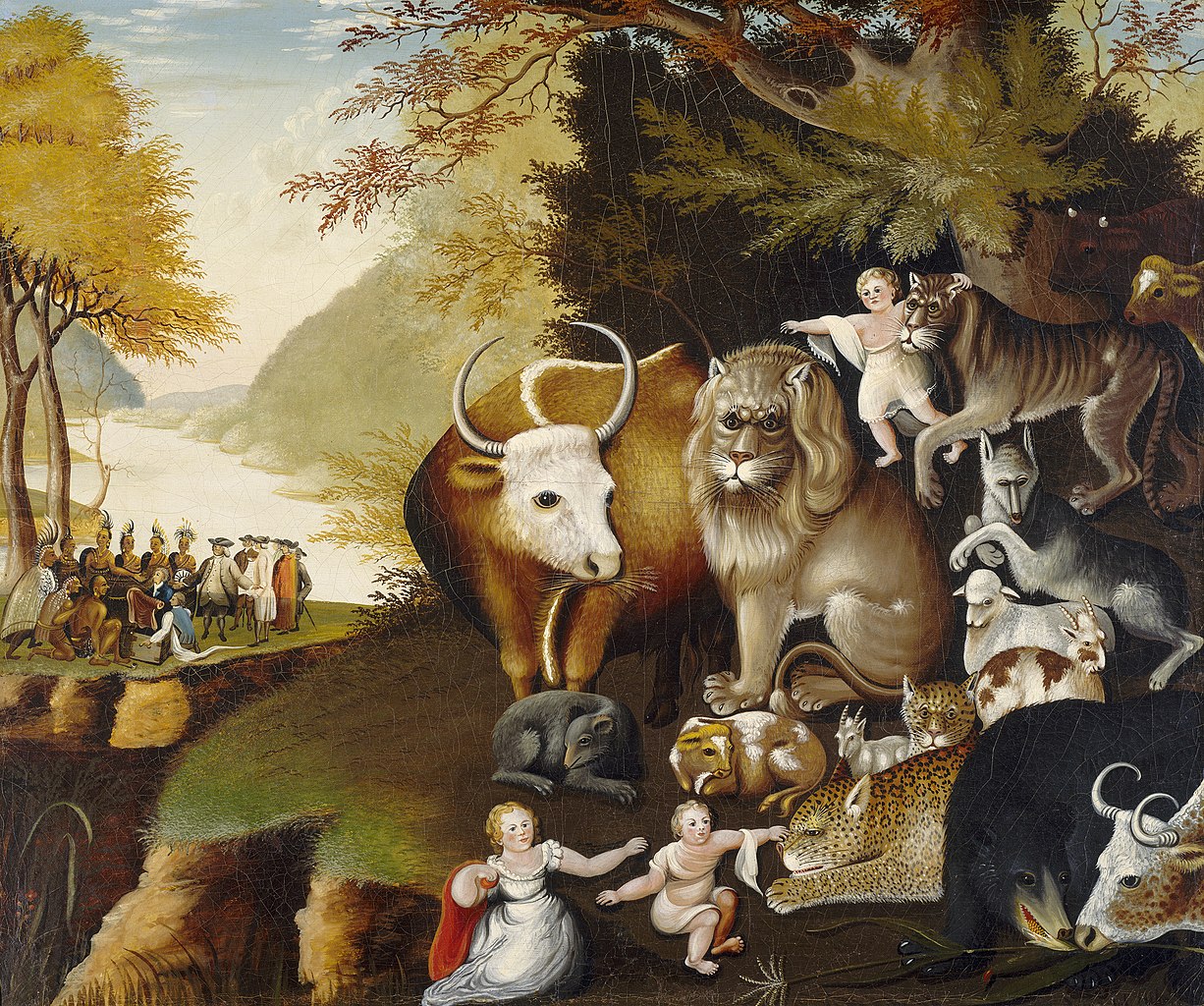
Edward Hicks, ‘Peaceable Kingdom’

The following post is taken from my recent INK article, which details the possible causes of the decline in inter-state war since 1945...


“The tide of war is receding,” President Obama proclaimed in 2011. Which is ironic, because Obama was referring to the seemingly intractable war in Afghanistan, which President Trump is set on continuing. But ultimately, Obama was right. Since the Second World War, the tide of war has receded—worldwide. Annual battle deaths have fallen 90% since 1950. War between countries has declined, the 2003 Iraq invasion being the only conflict this century meeting the criteria of a deadly inter-state war (though there remain a fair few civil wars with outside involvement). But why has full war between states become virtually extinct?

One explanation is democratisation. Between the 76-odd democratic states, peace prevails for two reasons, according to proponents of democratic peace theory such as Yale’s Bruce Russett. Firstly, politicians could simply be voted out of power if they use force against the public’s will, so the political cost of using force is greater in democracies than in non-democracies. Secondly, democracies expect to resolve domestic conflicts by compromise, leading them to “externalise” these internal norms and behave peacefully with other democracies. The last decade of relative peace may therefore be due in part to the sheer number of democracies. But inter-state war is uncommon worldwide, not just in the democratic sphere. To understand this, we need a more truly global explanation.

Such an explanation might be found in the process of globalisation, or the growing interdependence of the peoples of planet Earth. Economic interdependence has expanded apace this century, creating trade interests which do not favour war, argues Columbia University’s Michael Doyle. Maybe ‘perpetual peace’, in Kant’s famous phrase, requires commercial ties and free trade. So capitalism may be ‘a more powerful force for peace than democracy’, as academic Michael Mousseau put it.

For example, in 2014 the non-democratic regimes of China and Russia agreed a $400bn thirty-year contract to supply China with Russian gas. This economic interdependence should help to pacify relations, since commerce between countries reduces the incentive to go to war. But sometimes economic interdependence can exacerbate tensions: for instance, the EU fears that Russia will use Europe’s dependence on Russian energy to blackmail Europe, according to one recent analysis. Nevertheless, the fact that no EU member state has fought a war with Russia demonstrates the ability of some other mechanism to pacify relations.

This mechanism is liberalisation, or the creation of a liberal world order. Liberal institutions such as the EU, the OSCE and the UN employ soft power to make aggression seem more costly to a state’s reputation than pacifism. As Kant predicted, a “pacific union” is forming, established by various treaties of international law, softening normative conflicts between hostile states. These institutions also provide a home for a broad, constant conversation among nations. The development of the human rights regime has also bolstered cooperation and reduced the probability of inter-state war. The liberal world order, propped up for 70 years by the democratic, liberal-minded US, has contributed to the decline in violence between countries.

But cracks are showing in this liberal world order. Mirroring the US’s recent critiques of liberal institutions such as the EU, the UN and NATO, in 2016 China condemned a UN-mandated court’s rejection of Chinese claims to the South China Sea. From the rise of populism in Europe and the Trump-led US to the demagoguery of Putin, Erdogan and Duterte, identity-driven tribal politics within states is fuelling aggressive power politics between them. This threatens all three of the forces for peace we have discussed. The US’s democracy can hardly prevent the possibility of conflict with a rapidly growing China; in any case, the US is one of 89 countries in which the quality of democracy declined in 2017, according to The Economist. Globalisation is threatened by understandable though often misguided popular protests. And the US can hardly prop up a liberal world order which its leader views as unfair and anti-American. As the liberal empire of the post-war era retreats, so the spectre of war might advance.

But the collapse of peace is not unstoppable. Just as democratisation, globalisation and liberalisation progressively reduced conflict in past decades, they could do so in decades to come. Only by tackling inequality within and between states can we reduce the populist pressures that threaten the considerable achievements of the liberal world order. And only with awareness of the virtues of democracy, interdependence and liberal values can we make the future resemble the peaceful present rather than the conflicted past.


Image used under Creative Commons license.